 By bizn_fun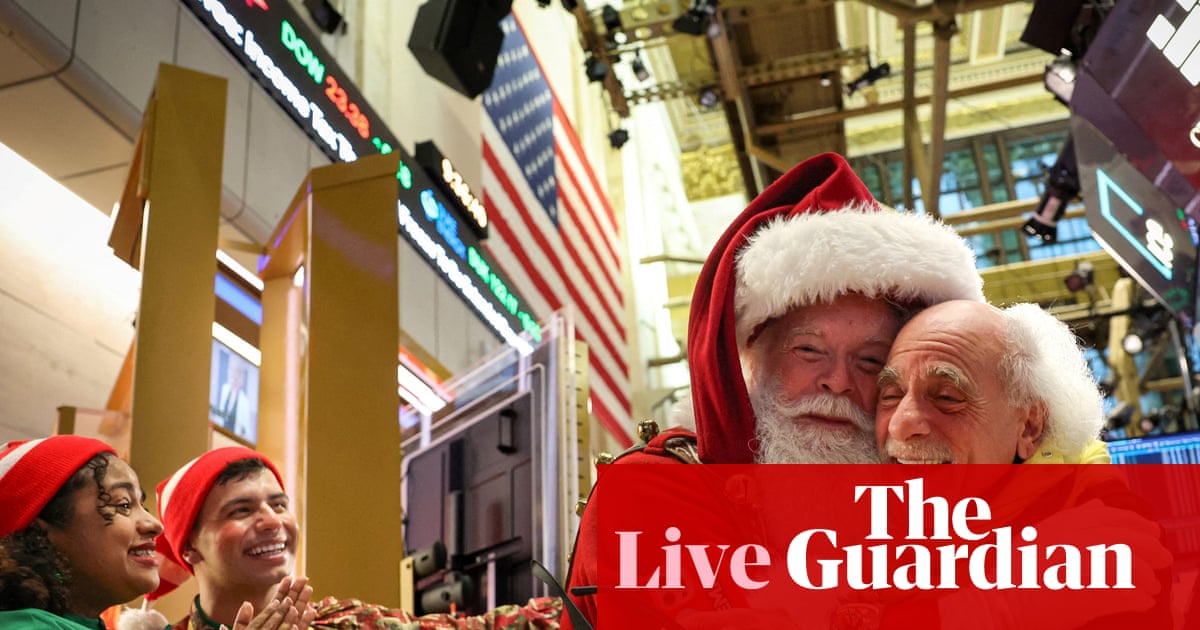
Introduction: Gold, silver and platinum hit record highs
Good morning, and welcome to our rolling coverage of business, the financial markets and the world economy.
Gold has climbed over the $4,500 per ounce mark for the first time ever, on the final trading day before Christmas.
As investors look for signs of a Santa Rally today, bullion has risen as high as $4,525 per ounce. Gold has risen for 11 of the last 12 days, taking its gains in 2025 to over 70%, its best year since 1979.
There’s a general frenzy in the precious metals market. Silver and platinum have also hit record highs, with silver reaching $72.16 an ounce and platinum climbing to $2,333.80 per ounce.
Investors are trying to hedge against geopolitical and trade risks, and also anticipate further US interest rate cuts in 2026; weakening the US dollar.
Ipek Ozkardeskaya, senior analyst at Swissquote, says:
We can say it: it’s been a golden year. Gold has renewed record highs more than 50 times this year and rose more than 70%, while silver’s gains have been even more impressive. The grey metal is up around 150% since January, driven by the so-called debasement trade — the idea that fiat currencies lose purchasing power over time due to heavy debt, persistent deficits, loose monetary policy and financial repression (rates below inflation). Add rising demand for silver and copper to limited supply, and the performance of these metals becomes easier to explain.
The reasonable answer is that the forces pushing metal prices higher remain firmly in place: heavy government debt into 2026 — check; persistent and widening deficits in developed markets — check; loose monetary policy and low real yields — check; geopolitical uncertainty — check; tight supply and rising demand — check. In theory, the medium- to long-term outlook remains positive.
The agenda
Key events
Oil at two-week high amid heightened geopolitical tensions
The oil price has hit its highest level in two weeks, driven up by robust US economic growth and the risk of supply disruptions from Venezuela and Russia.
Brent crude has gained 0.5% this morning to $62.72 per barrel, the highest since 10 December.
Today’s gains come as the US continues to impose blockage sanctioned oil tankers entering and leaving Venezuela, leading to supply shortage fears.
Yesterday’s news that the American economy grew faster than expected in July-September could indicate higher demand for energy
IG analyst Tony Sycamore says:
“What we’ve seen over the past week is a combination of position squaring in thin markets, after last week’s breakdown failed to gain traction, coupled with heightened geopolitical tensions, including the US blockade on Venezuela and supported by last night’s robust GDP data.”
Oil has gained about 6% since December 16, when it plunged to near five-year lows.
Earlier this week China and Russia have expressed support for Venezuela, as Donald Trump ramped up his pressure campaign on the South American country’s president, Nicolás Maduro.
CDs return to Christmas shopping lists as gen Z embrace ‘retro renaissance’
It’s not too late to snaffle some last-minute Christmas presents (unless, ahem, you’re still toiling away at your desk).
And if you have a Gen-Zer on your list, you might want to check out ‘retro tech’ options.
Kit such as CD players and compact discs are back on Christmas lists this year amid a wave of 90s nostalgia.
John Lewis has upped its range of CD players to meet resurgent demand and says sales are up 74% in the last year. “We’re seeing something of a retro renaissance,” said Heather Andrews, one of its electricals buyers.
The format’s cause is being helped by the return of classic 90s acts such as Oasis and Pulp (ah, the good old days….). More here:
There’s also a quiet start to trading across Europe, at least at the stock markets which are open today.
The Stoxx 600 share is up a mere 0.04%, just below the record high touched yesterday.
The Paris, Amsterdam, and Brussels bourses are open today for a half-day (as is London), while Frankfurt, Milan and Zurich are closed.
FTSE 100 opens slightly lower
There’s no sign of the fabled Santa rally yet, with the London stock market a little lower in early trading.
The FTSE 100 share index has dipped by four points to 9,885 points, 45 points away from its all-time high.
Shares in BP have jumped by 1.5% at the start of today’s shortened trading session in London.
They’ve risen to $433.30, the highest in over a week, as investors welcome the sale of a 65% stake in its Castrol lubricants division for $6bn to cut its debt.
Pound at three-month high against weaker dollar
The pound has hit its highest level against the US dollar in three months.
Sterling hit $1.3534 early this morning, its strongest level since 24 September.
The dollar is weaker despite surprisingly strong US economic growth data yesterday, with traders anticipating a slowdown in the current quarter.
BP to sell 65% stake in Castrol to Stonepeak for $6bn
We have some Christmas Eve deal action – BP has agreed to sell a majority stake in its Castrol division to US investment firm Stonepeak Partners for $6bn.
The UK oil giant will divest a 65% stake in the lubricants unit, in a deal that values Castrol at $10.1 billion including debt.
This is a significant step in BP’ push to sell $20bn of assets, to reduce its debt pile – just days after it ousted its CEO, Murray Auchincloss, and appointed Meg O’Neill as its first female chief executive.
Carol Howle, interim CEO at bp, said:
“Today’s announcement is a very good outcome for all stakeholders. We concluded a thorough strategic review of Castrol, that generated extensive interest and resulted in the sale of a majority interest to Stonepeak.
The transaction allows us to realise value for our shareholders, generating significant proceeds while continuing to benefit from Castrol’s strong growth momentum. And with this, we have now completed or announced over half of our targeted $20bn divestment programme, with proceeds to significantly strengthen bp’s balance sheet. The sale marks an important milestone in the ongoing delivery of our reset strategy.
We are reducing complexity, focusing the downstream on our leading integrated businesses, and accelerating delivery of our plan. And we are doing so with increasing intensity – with a continued focus on growing cash flow and returns, and delivering value for our shareholders.”
Will we get a Santa Rally?
Today is traditionally the start of the Santa Rally period, the period at the end of the year when stock markets tend to rise.
However, Santa may be late this year – FTSE futures are down 0.07% this morning, a day after the UK’s stock market closed near to a record high.
Introduction: Gold, silver and platinum hit record highs
Good morning, and welcome to our rolling coverage of business, the financial markets and the world economy.
Gold has climbed over the $4,500 per ounce mark for the first time ever, on the final trading day before Christmas.
As investors look for signs of a Santa Rally today, bullion has risen as high as $4,525 per ounce. Gold has risen for 11 of the last 12 days, taking its gains in 2025 to over 70%, its best year since 1979.
There’s a general frenzy in the precious metals market. Silver and platinum have also hit record highs, with silver reaching $72.16 an ounce and platinum climbing to $2,333.80 per ounce.
Investors are trying to hedge against geopolitical and trade risks, and also anticipate further US interest rate cuts in 2026; weakening the US dollar.
Ipek Ozkardeskaya, senior analyst at Swissquote, says:
We can say it: it’s been a golden year. Gold has renewed record highs more than 50 times this year and rose more than 70%, while silver’s gains have been even more impressive. The grey metal is up around 150% since January, driven by the so-called debasement trade — the idea that fiat currencies lose purchasing power over time due to heavy debt, persistent deficits, loose monetary policy and financial repression (rates below inflation). Add rising demand for silver and copper to limited supply, and the performance of these metals becomes easier to explain.
The reasonable answer is that the forces pushing metal prices higher remain firmly in place: heavy government debt into 2026 — check; persistent and widening deficits in developed markets — check; loose monetary policy and low real yields — check; geopolitical uncertainty — check; tight supply and rising demand — check. In theory, the medium- to long-term outlook remains positive.