 By bizn_fun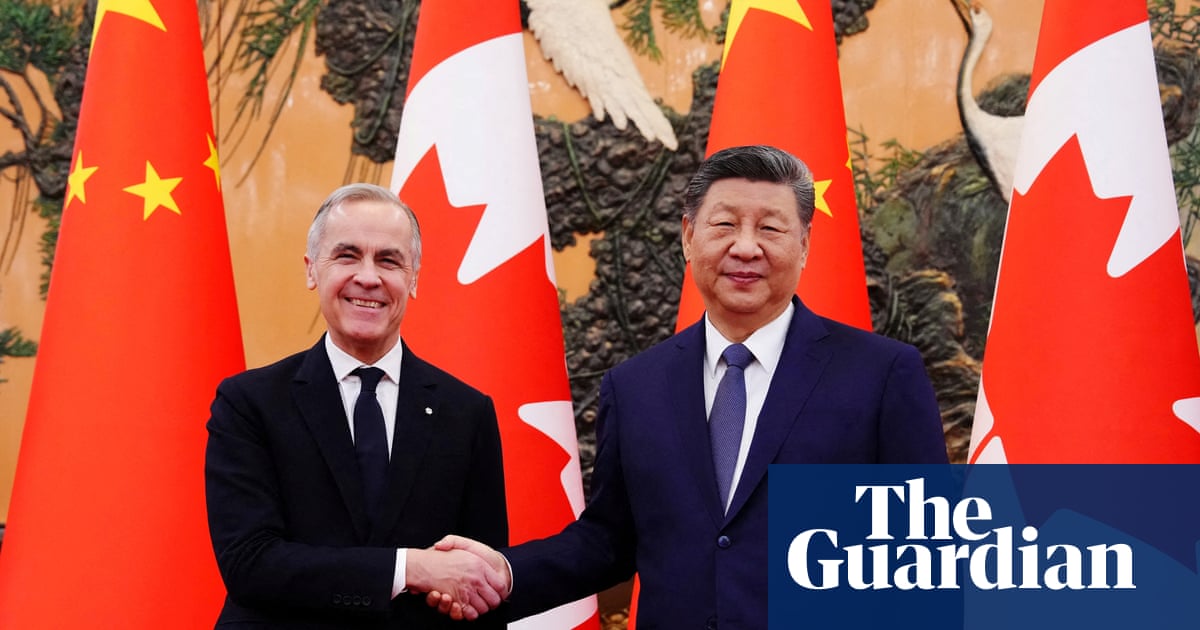
Canada’s prime minister, Mark Carney, has hailed a “new strategic partnership” with China as he held talks in Beijing with President Xi Jinping, the first visit there by a Canadian leader in eight years.
Addressing Xi in the Great Hall of the People, Carney said: “Together we can build on the best of what this relationship has been in the past to create a new one adapted to new global realities.”
Carney announced on Friday that he had reached a “preliminary” trade deal with China to reduce tariffs. That includes a promise to import 49,000 electric vehicles from China at preferential tariff rates.
Engagement and cooperation would be “the foundation of our new strategic partnership”, Carney said. “Agriculture, energy, finance, that’s where we can make the most immediate progress.”
Canada and China had been locked in years of diplomatic spats after the retaliatory arrests of each other’s citizens and a series of tit-for-tat trade disputes.
But Carney has sought to turn the page in a move to reduce reliance on the US, its key economic partner, as president Donald Trump aggressively raised tariffs on Canadian products.
Carney’s state visit, the result of methodical diplomatic calculations, speaks to the pain of a trade war with the US and an urgent need to expand Canada’s exports in order to offset mounting economic punishment inflicted by its neighbour and largest trading partner.
The two sides signed an agreement to cooperate on clean energy and fossil fuels, re-opening ministerial level talks that have reportedly been frozen for nearly a decade.
The agreement opens the door to Canada importing more clean energy technology from China. It also raises the possibility of Canada increasing its fossil fuel exports to China, part of Carney’s push to double non-US exports. In 2024, only 2% of Canada’s crude oil was exported to China.
China and Canada also signed agreements on forestry, culture and tourism.
Welcoming Carney, Xi said China-Canada relations reached a turning point at their last meeting on the sidelines of the Apec summit in October 2025.
“It can be said that our meeting last year opened a new chapter in turning China-Canada relations toward improvement,” Xi told the Canadian prime minister.
“The healthy and stable development of China-Canada relations serves the common interests of our two countries,” he said, adding he was “glad” to see discussions over the last few months to restore cooperation.
Ties between the two nations withered in 2018 over Canada’s arrest of Meng Wanzhou, the daughter of Huawei’s founder on a US warrant, and China’s retaliatory detention of two Canadians on espionage charges.
The two countries imposed tariffs on each other’s exports in the years that ensued, with China also being accused of interfering in Canada’s elections.
But Carney has sought a pivot, and Beijing has also said it is willing to get relations back on “the right track”.
The Canadian prime minister, who on Thursday met China’s premier, Li Qiang, is also scheduled to hold talks with business leaders to discuss trade.
Canada, traditionally a staunch US ally, has been hit especially hard by Trump’s steep tariffs on steel, aluminium, vehicles and lumber. In October, Carney said Canada should double its non-US exports by 2035 to reduce reliance on the US.
However, the US remains far and away its largest market, buying about 75% of Canadian goods in 2024, according to Canadian government statistics. While Ottawa has stressed that China is Canada’s second-largest market, it lags far behind, buying less than 4% of Canadian exports in 2024.
Officials from Canada and China have been in talks to lower tariffs and boost bilateral trade, though an agreement has yet to be reached.
Agence France-Presse contributed to this report