 By bizn_fun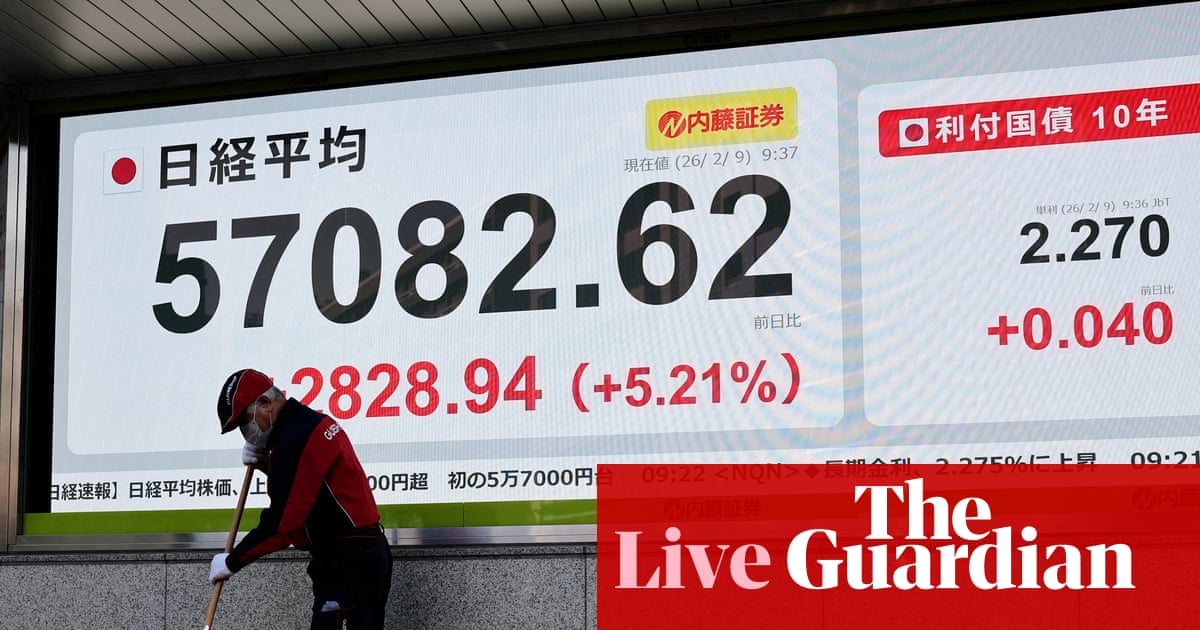
Introduction: Japan’s Nikkei hits record high and yen strengthens after Takaichi’s election win
Good morning, and welcome to our rolling coverage of business, the financial markets and the world economy.
Political drama will be on investors’ minds today, as they react to a landmark election in Tokyo and mounting pressure on UK prime minister Keir Starmer.
The yen has strengthened after Japanese prime minister Sanae Takaichi won a sweeping victory in Sunday’s election, ending a six-day run of losses.
The Japanese stock market has rocketed to a new high too, as investors welcome the prospect of more stimulus.
Takaichi’s Liberal Democratic party (LDP) has won an absolute majority in Japan’s lower house, and with her coalition partner, the Japan Innovation party, Takaichi now has a supermajority of two-thirds of seats.
This will smooth the way for Takaichi to push through a 21tn yen (£99bn) stimulus package, and her pledge to suspend Japan’s 8% sales tax on food for two years.
Those plans had rattled financial markets and caused currency volatility during the election campaign, but there’s now relief that Japan’s political uncertainty appears to be over.
ING say the LDP’s landslide victory in Japan is positive for risk assets, even though her policies could raise Japan’s borrowing levels even higher:
Prime minister Takaichi’s decision to leverage her popularity for her party turned out to be successful.
The landslide victory will reinforce her responsible but expansionary fiscal spending and a more Japan-focused foreign policy. Risk-on sentiment will dominate the market for now.
Japan’s Nikkei share average surged to a record high on Monday, after the election results, surpassing the 56,000 level for the first time at the start of trading. It quickly pushed through the 57,000 point mark, before closing up 3.9% at 56,363 points.
Stock markets like extra fiscal stimulus. After Sanae Takaichi secured Japan’s largest postwar election victory, Nikkei 225 surged over 5% at Monday’s open. Equities had already outperformed in the four months since she took command of the LDP, even accounting for the weak yen pic.twitter.com/uH2AMA7WrS
— Rymond_Inc (@rymondIncKenya) February 9, 2026
The agenda
-
Noon BST: European Central Bank chief economist Philip Lane gives lecture at Maynooth University
-
4pm BST: ECB presidnt Christine Lagarde participates in plenary debate on the state of the EU economy and ECB activities in Strasbourg, France
Key events
Asia-Pacific markets are rallying across the board today, as traders anticipate a boost from a new fiscal spending programme.
South Korea’s KOSPI has surged by 4.4%, outpaced the Japanese Nikkei’s 3.9% rise. Hong Kong’s Hang Seng has gained 1.75%, and Australia’s S&P/ASX 200 is 1.85% higher.
Ipek Ozkardeskaya, senior analyst at Swissquote, explains why:
The good news is that Japanese Prime Minister Sanae Takaichi won — and won big — her bet in the weekend snap election. She pulled off a stunning victory, with her ruling Liberal Democratic Party (LDP) scoring a historic landslide and securing a two-thirds supermajority in the powerful lower house of parliament — even more if you include its coalition partner.
That gives her party its most dominant position in decades and a strong mandate to push through an expansive fiscal agenda, particularly benefiting defense and technology. This likely helps explain why South Korea’s Kospi rebounded nearly 4% today. Still, the tech rebound could face speed bumps ahead.
The yen is up 0.5% against the US dollar, at ¥156.40/$.
That may seen counter-intuitive, as Sanae Takaichi now has a green light to push through with her debt-funded expansionary policies.
Reuters suspects investors are taking profits after having bet against the yen in the run-up to the election. There’s also the possibility that Tokyo might intervene if the yen weakens closer to the ¥160/$ level.
Introduction: Japan’s Nikkei hits record high and yen strengthens after Takaichi’s election win
Good morning, and welcome to our rolling coverage of business, the financial markets and the world economy.
Political drama will be on investors’ minds today, as they react to a landmark election in Tokyo and mounting pressure on UK prime minister Keir Starmer.
The yen has strengthened after Japanese prime minister Sanae Takaichi won a sweeping victory in Sunday’s election, ending a six-day run of losses.
The Japanese stock market has rocketed to a new high too, as investors welcome the prospect of more stimulus.
Takaichi’s Liberal Democratic party (LDP) has won an absolute majority in Japan’s lower house, and with her coalition partner, the Japan Innovation party, Takaichi now has a supermajority of two-thirds of seats.
This will smooth the way for Takaichi to push through a 21tn yen (£99bn) stimulus package, and her pledge to suspend Japan’s 8% sales tax on food for two years.
Those plans had rattled financial markets and caused currency volatility during the election campaign, but there’s now relief that Japan’s political uncertainty appears to be over.
ING say the LDP’s landslide victory in Japan is positive for risk assets, even though her policies could raise Japan’s borrowing levels even higher:
Prime minister Takaichi’s decision to leverage her popularity for her party turned out to be successful.
The landslide victory will reinforce her responsible but expansionary fiscal spending and a more Japan-focused foreign policy. Risk-on sentiment will dominate the market for now.
Japan’s Nikkei share average surged to a record high on Monday, after the election results, surpassing the 56,000 level for the first time at the start of trading. It quickly pushed through the 57,000 point mark, before closing up 3.9% at 56,363 points.
Stock markets like extra fiscal stimulus. After Sanae Takaichi secured Japan’s largest postwar election victory, Nikkei 225 surged over 5% at Monday’s open. Equities had already outperformed in the four months since she took command of the LDP, even accounting for the weak yen pic.twitter.com/uH2AMA7WrS
— Rymond_Inc (@rymondIncKenya) February 9, 2026
The agenda
-
Noon BST: European Central Bank chief economist Philip Lane gives lecture at Maynooth University
-
4pm BST: ECB presidnt Christine Lagarde participates in plenary debate on the state of the EU economy and ECB activities in Strasbourg, France