 By bizn_fun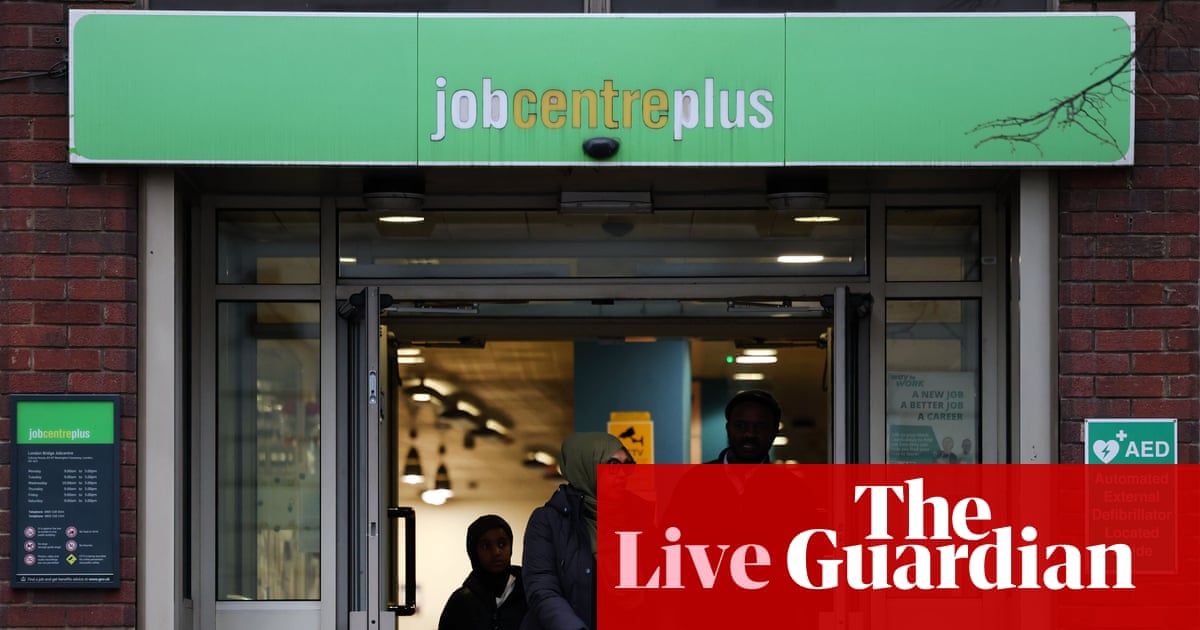
Bank of England ‘firmly on track’ to cut interest rates in March
The chances of a cut to UK interest rates next month have risen, following this morning’s data showing a rise in unemployment and a slowdown in wage growth.
The City money markets now indicate there’s a near-75% chance that the Bank of England lowers interest rates to 3.5% at its next meeting, in March, up from 69% last night.
Investors now fully expect two rate cuts by Christmas, which would bring Bank Rate down to 3.25%.
James Smith, developed markets economist at ING, says today’s UK jobs report keeps the Bank of England “firmly on track” for a March rate cut.
Smith says:
Unemployment is up and hiring surveys are still getting worse. That said, the weakness is still heavily concentrated in consumer-facing industries – a legacy of last year’s sizable payroll tax (National Insurance) and National Living Wage increases. Hospitality payrolled employment may be down almost 3% since the start of 2025, but it is still 2% higher than pre-Covid levels. Yet economic output is still 6% below – suggesting the loss of jobs may have further to run.
Outside of these consumer-centric industries, the story looks more benign. Employment is still trending down across the wider private sector on a three-month average of payrolls growth, but only slightly. We’re also not seeing a particularly noticeable pick-up in redundancies across the economy. Vacancy numbers have stopped falling, too.
Yael Selfin, chief economist at KPMG UK, says the fall in pay growth to 4.2% strengthens the case for a March interest rate cut:
“Today’s data raises the prospect of the Bank of England resuming cutting interest rates in March. The MPC will be reassured by further evidence of pay pressures easing, and the labour market continuing to soften. The Bank may also want to minimise downside risks to the labour market and lower rates ahead of the next forecast meeting in April.
“Headline pay growth eased in December, falling from 4.4% to 4.2%. The fall in headline pay was partly driven by an easing in public sector wage settlements, which fell for the first time since July 2025. Demand for labour remains weak which has curtailed workers’ bargaining power, meanwhile falling costs for households should also temper pay demand amongst workers. We expect pay growth to fall to 3% by the end of 2026.
Key events
Disappointingly, UK labour productivity deteriorated in the last three months of 2025.
The Office for National Statistics has estimated that output per hour worked in Quarter 4 2025 was 0.5% lower compared with Quarter 4 2024, while output per worker decreased by 0.2% compared with the same period.
The ONS says:
The information and communication industry made the biggest positive contribution to productivity growth, compared with the 2019 average; this was caused by a larger increase in gross value added (GVA) compared with hours worked.
Financial and insurance activities made the biggest negative contribution to productivity growth, compared with the 2019 average; this was caused by a small increase in the number of hours worked, alongside a more significant fall in output.
Company insolvencies rose in January
Another worrying development: the number of English and Welsh companies falling into insolvency rose by 4% in January, getting the new year off to a bad start.
HMRC data shows there were 1,744 registered company insolvencies in England and Wales last month, up from 1,683 in December.
On an annual basis, though, it’s 14% lower than in January 2025 (when there were 2,028 insolvencies).
HMRC reports:
Company insolvencies in January 2026 consisted of 256 compulsory liquidations, 1,323 creditors’ voluntary liquidations (CVLs), 151 administrations and 13 company voluntary arrangements (CVAs). There was one receivership appointment
Youth unemployment at joint 10-year high
The UK’s youth unemployment rate hasn’t been higher in a decade.
The 14% jobless rate recorded in October-December 2025 among the UK’s 18-24 year olds was last seen in July-September 2020, when Covid-19 lockdowns hit demand for workers.
To get a higher rate than 14%, you need to go back to April-June 2015 when it was 14.2%.
Louise Murphy, senior economist at the Resolution Foundation, says the UK’s unemployment problems need urgent attention:
At the end of last year almost one-in-six young people who wanted to work couldn’t find a job. Unemployment risks climbing even further in 2026.
“Many European countries have long grappled with high levels of youth unemployment and their efforts have pulled their rate below that of the UK. Getting youth unemployment down in this country – along with the share of young people who aren’t in education or training either – must be a top priority for 2026.”
Naomi Clayton, chief executive at the Institute for Employment Studies said:
“Unemployment is edging upwards as hiring remains weak. Payrolled employment continues to fall, though at a slower rate, and vacancies appear to have stabilised. Rising unemployment and weak hiring means that there are more people looking for fewer jobs and, outside the pandemic, the unemployment-to-vacancy ratio is the highest in 10 years.
Young people are being hit hardest, with youth unemployment at its highest in a decade. The government needs to work with employers to boost jobs and encourage hiring, while expanding support to help people find work.”
Full story: UK unemployment rate hits five-year high of 5.2% as wage growth cools
Tom Knowles
Unemployment in the UK has risen to 5.2%, the highest level in nearly five years, while wage growth continues to slow, raising the prospect of another cut to interest rates in the spring.
The Office for National Statistics (ONS) said the rate of unemployment was 5.2% in the three months to the end of December, the highest rate since the quarter to January 2021. This was in line with what economists had been expecting and was up from 5.1% in the three months to November.
Joblessness in the UK has steadily risen since 2022, and businesses have complained that tax rises by Rachel Reeves in her last two budgets have exacerbated this, with rises in national insurance contributions and the minimum wage causing particular issues.
In the three months to December, wages excluding bonuses in Great Britain increased by 4.2%, easing from 4.4% the previous month.
In the private sector, pay rose by 3.4%, the lowest level in five years, while wages in the public sector rose by 7.2%. Once adjusted for inflation, annual pay excluding bonuses rose by just 0.8% in October to December, the lowest rate since August 2023.
The number of people on company payrolls also continued to fall, down 134,000 on a year ago, and by 46,000 over the quarter. On a monthly basis, payrolls fell by 11,000 in January.
More here:
UK bond yields drop
UK government borrowing costs are dropping this morning, as the weakening jobs market puts pressure on the Bank of England to cut interest rates.
The yield, or interest rate, on two-year UK gilts has dipped by two basis point (0.02 percentage points) this morning. That’s a small move, reflecting the increased expectations of a rate cut in March.
The yield on benchmark 10-year gilts is down 2 basis points too, to 4.368%. That’s a one-month low, eliminating the rise in borrowing costs during the political furore over Keir Starmer’s future earlier this month.
That will be welcomed by the government, as it indicates that the cost of servicing the national debt has dropped.
Yesterday, Bloomberg reported that chancellor Rachel Reeves is on track to bank an extra £1.5bn in lower borrowing costs at her spring statement in March, compared to her budget last November. That’s because yields on 10-year gilts have fallen 25 basis points over that time.
Unemployment rises: the political reaction
Work and Pensions Secretary Pat McFadden says the government is taking steps to help young people into work:
“Today’s figures show there are 381,000 more people in work since the start of 2025, but we know there is more to do to get people into jobs.
“Our £1.5 billion drive to tackle youth unemployment is a key priority and this month we announced that we’ll make it easier for young people to find and secure an apprenticeship, which comes on top of our investment to create 50,000 new apprenticeships.”
But Shadow work and pensions secretary Helen Whately blames the government for fuelling the youth unemployment crisis:
“An unprecedented series of monthly unemployment increases is the hallmark of this Labour Government.
“The predictable result of bad decisions and economic incompetence.
“Young people are taking the hardest hit. Entry-level roles are the first to disappear from Labour’s tax hikes. By making hiring more expensive and more risky, Labour have are ensuring school leavers and graduates never even get a foot in the door.”
Pound drops
The pound is weakening, as traders anticipate the Bank of England could cut interest rates next month.
Sterling has fallen by two-thirds of a cent against the US dollar, to $1.355, its lowest rate since 6 February.
Kathleen Brooks, research director at XTB, says the pound is the weakest major currency on the foreign exchanges this morning:
The market reaction has been swift. The pound has sunk on this news, GBP/USD is down by 70 points and it has lost the $1.36 handle. It is the weakest currency in the G10 FX space on Tuesday, and the pound is now trailing behind the dollar, and is the weakest currency in the G10 so far this month.
As the UK economy softens, the bias is to the downside for sterling.
Bank of England ‘firmly on track’ to cut interest rates in March
The chances of a cut to UK interest rates next month have risen, following this morning’s data showing a rise in unemployment and a slowdown in wage growth.
The City money markets now indicate there’s a near-75% chance that the Bank of England lowers interest rates to 3.5% at its next meeting, in March, up from 69% last night.
Investors now fully expect two rate cuts by Christmas, which would bring Bank Rate down to 3.25%.
James Smith, developed markets economist at ING, says today’s UK jobs report keeps the Bank of England “firmly on track” for a March rate cut.
Smith says:
Unemployment is up and hiring surveys are still getting worse. That said, the weakness is still heavily concentrated in consumer-facing industries – a legacy of last year’s sizable payroll tax (National Insurance) and National Living Wage increases. Hospitality payrolled employment may be down almost 3% since the start of 2025, but it is still 2% higher than pre-Covid levels. Yet economic output is still 6% below – suggesting the loss of jobs may have further to run.
Outside of these consumer-centric industries, the story looks more benign. Employment is still trending down across the wider private sector on a three-month average of payrolls growth, but only slightly. We’re also not seeing a particularly noticeable pick-up in redundancies across the economy. Vacancy numbers have stopped falling, too.
Yael Selfin, chief economist at KPMG UK, says the fall in pay growth to 4.2% strengthens the case for a March interest rate cut:
“Today’s data raises the prospect of the Bank of England resuming cutting interest rates in March. The MPC will be reassured by further evidence of pay pressures easing, and the labour market continuing to soften. The Bank may also want to minimise downside risks to the labour market and lower rates ahead of the next forecast meeting in April.
“Headline pay growth eased in December, falling from 4.4% to 4.2%. The fall in headline pay was partly driven by an easing in public sector wage settlements, which fell for the first time since July 2025. Demand for labour remains weak which has curtailed workers’ bargaining power, meanwhile falling costs for households should also temper pay demand amongst workers. We expect pay growth to fall to 3% by the end of 2026.
What the experts say
Here’s some snap reaction to the rise in UK unemployment:
Jonathan Raymond, investment manager at Quilter Cheviot, says there are signs that the UK labour market is ‘creaking’:
“Following a November where hiring plans were put on hold due to the budget, things are yet to get going again, potentially highlighting the longer-term impacts of increases costs that businesses have faced.
Increased minimum wage costs, national insurance contributions, business rates and concerns around the impact of the Employment Rights Act continues to show up in the data and appears to be putting a weight on the economy. Economic indicators were beginning to shine some positivity but that has arguably been wiped by this latest data.
Patrick Milnes, Head of People and Work Policy at the British Chambers of Commerce, blames those rising employment costs:
“There are strong signs that the labour market is continuing to loosen as wage growth including bonuses has eased to 4.2% and the rate of unemployment has risen to 5.2%.
“Wage growth is being propped up by the public sector and the number of unemployed people per vacancy now sits at 2.6, the highest in more than 10 years if the pandemic period is excluded.
“Last year, businesses were hit hard by the increase in National Insurance contributions, and many are now facing further rises in the National Living Wage alongside higher business rates. Our research shows that labour costs remain the biggest cost pressure for businesses, cited by 72% of businesses.
“Against this background it is unsurprising they are holding off hiring. Especially as the imminent introduction of new Employment Rights legislation adds additional complexity to the picture.
“While the Spring Statement will provide a fuller update on the economic outlook, businesses are clear they want to see concrete action to reduce costs, boost exports and encourage investment.”
Ben Harrison, Director of the Work Foundation at Lancaster University, says today’s figures show a weakening and uneven labour market, with more people looking for work and with young people particularly hit:
“While overall employment appears broadly stable and the rise in redundancies has slowed, the pain is not evenly spread. Young people, disabled people and men are bearing the brunt of the rise.
“Youth unemployment is now at 14.0%, the highest rate for five years. This is particularly concerning as the number of 18-24 year olds out of work has jumped by 80,000 on the quarter to 575,000. More young people are actively seeking work, but too many are struggling to secure it.
“Vacancies remain subdued at 726,000, despite a slight uptick on the quarter. The Government clearly recognises the need to provide more support to help people back into work but many initiatives – such as jobs on wheels and youth guarantees – remain in pilot phases.
“To Get Britain Working, Ministers must prioritise a twin focus on rapidly expanding tailored employment support and ensuring those returning to work are able to access secure, and well-paid jobs across the country.”
Unemployment rate among 18-24 year olds rises to five-year high
Peter Dixon, senior economist at the National Institute of Economic and Social Research, has spotted that the number of young people out of work has risen:
At 14%, the unemployment rate among 18-24 year olds has hit its highest level since July-September 2020, more than five years ago
Dixon says:
Below the surface, there are indications that younger workers in particular are being priced out of the market.
A rise of 33 per cent in the minimum wage over the past two years has pushed up the unemployment rate for 18-24 year olds by more than two percentage points to 14 per cent.
With a further inflation-plus rise in the minimum wage for 18-20 year olds scheduled for April, young workers will continue to struggle to gain a foothold in the labour market in the near-term.”
The ONS also estimate that firms kept cutting workers in January.
Its early, provisional, estimate of payrolled employees for January 2026 shows a decrease of 11,000 within the month, meaning payrolls were 134,000 lower than a year ago.
The rise in unemployment means competition for vacancies is intensifying.
There were 2.6 unemployed people per vacancy in October to December 2025, up from 2.5 in the previous quarter (July to September 2025) and up from 1.9 in October to December 2024.
Pay rose faster in the public sector than at private companies in the last quarter of 2025, today’s labour market report shows.
Annual average regular earnings growth was 7.2% for the public sector, more than twice as fast as the 3.4% increase in the private sector, the ONS reports.
That’s quite a difference… but if you dig into the jobs report, you can see that the public sector annual growth rate is affected by some public sector pay rises being paid earlier in 2025 than in 2024.
That causes a base effect, which should phase out over the next few months.
Real wages rise by just 0.8%
UK pay growth was particularly weak in the last quarter of 2025 once you account for inflation.
Today’s labour market data shows that annual real regular pay (ex-bonuses) rose by just 0.8% in October to December 2025 – that’s using the Consumer Prices Index measure of inflation.
Real pay was last lower than 0.8% in June to August 2023, when it was 0.7%, the ONS reports.
Introduction: UK unemployment hits highest since early 2021
Good morning. Unemployment across the UK has hit a near five-year high, and wage growth has slowed.
The latest labour market data, just released this morning, shows that the UK jobless rate rose to 5.2% in the October-December quarter.
That’s up from 5.1% in September-November, and the highest rate since the first quarter of 2021.
The number of workers on company payrolls fell too – down by 130,000 over the year and by 46,000 over the quarter.
This follows many months of complaints from businesses that chancellor Rachel Reeves has pushed up employment costs, through increases in national insurance contributions and the minimum wage.
Earnings growth cooled in the quarter too. Basic pay (excluding bonuses) rose by 4.2% in the October-December quarter, down from 4.4% a month ago.
Total earnings (including bonuses) growth also slowed to 4.2%, down from 4.6% in September to November 2025.
ONS Director of Economic Statistics Liz McKeown said:
“The number of workers on payroll fell further in the final quarter of the year, reflecting weak hiring activity, although it is largely unchanged in the latest month. Over the same period the unemployment rate increased, with data showing that more people who were out of work are now actively looking for a job.
“The number of vacancies has remained broadly stable since the middle of last year. Alongside rising unemployment this means that the number of unemployed people per vacancy has increased, reaching a new post-pandemic high. Meanwhile, redundancies are also showing an upward trend.
“Private sector wage growth continues to slow and is at its lowest rate in five years. Public sector pay growth also slowed in the latest period but remains elevated, still affected by some pay awards being implemented earlier in 2025 than 2024, although this effect has now started to diminish.”
The agenda
-
7am GMT: UK labour force data
-
7am GMT: German inflation report
-
9.30am GMT: UK productivity data for Q4 2025
-
10am GMT: ZEW’s eurozone economic sentiment survey
-
1.30pm GMT: NY Empire State Manufacturing Index